ROCE vs ROE – Breaking down the key differences
- 5 min read•
- 1,304•
- Published 18 Dec 2025
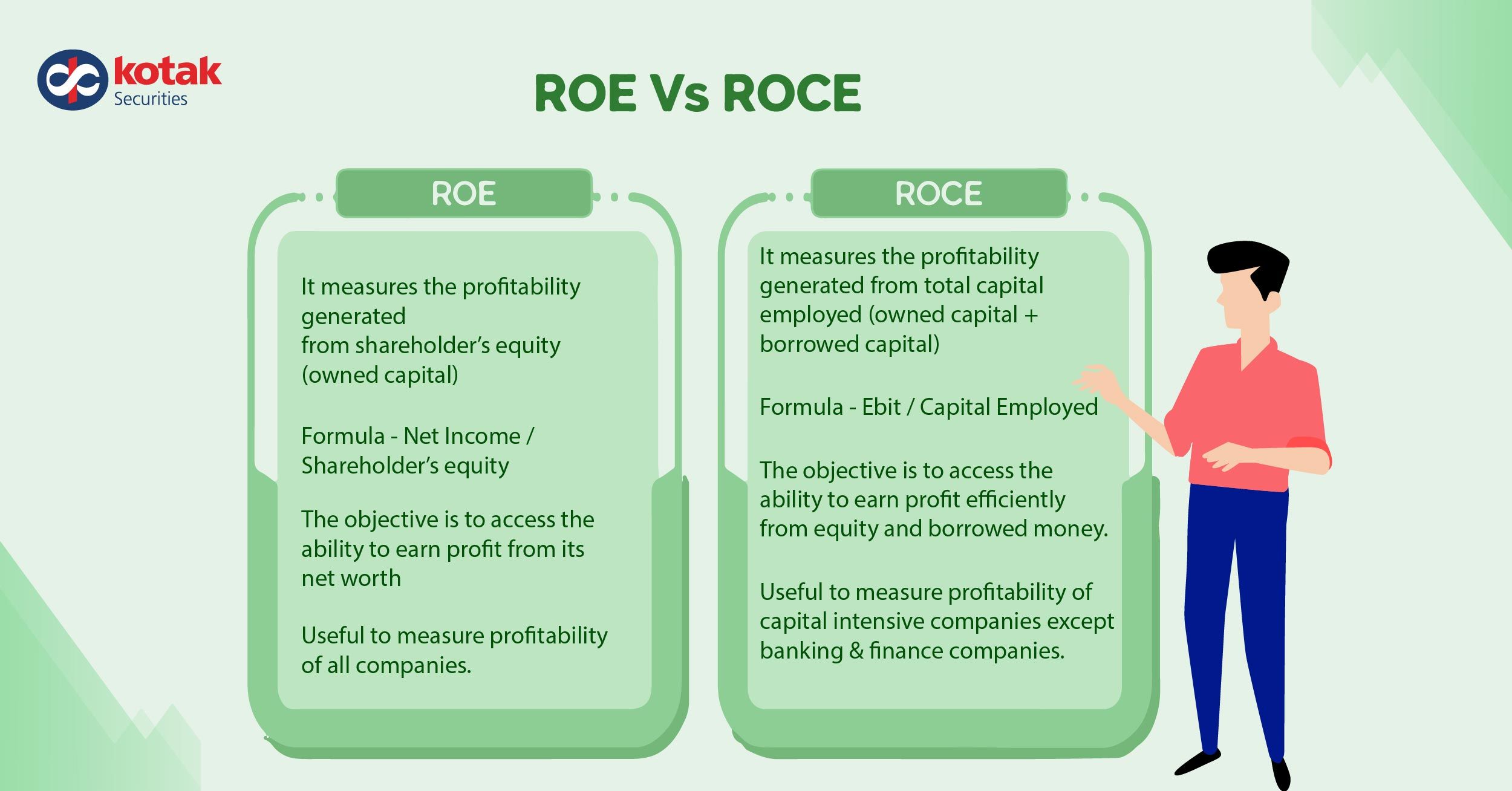
Fundamental analysis is a key factor when choosing between investment options, and ratios are considered the backbone of fundamental analysis. Here, two key ratios based on how a company is using its capital are Return on Capital Employed (ROCE) and Return on Equity (ROE). Read on to learn more about the differences between ROE and ROCE and understand how it can help your investment decisions.
What is ROCE?
ROCE is a ratio that determines the efficiency of a firm in utilising its capital. It reflects the capacity of the business to generate returns on the total amount of capital used, which consists of equity and debt but does not include short-term debt.
The formula to determine ROCE is -
ROCE = Earnings Before Interest and Taxes (EBIT) / Capital Employed
Where
EBIT = Net Profit + Interest + Taxes
Capital Employed = Total Assets - Current Liabilities
Higher ROCE means the company is earning more profits per unit of capital. This reflects effective utilisation of capital to create shareholder value.
Consider two companies - A Ltd and B Ltd
- A Ltd has EBIT of Rs. 50 crores and Capital Employed of Rs. 250 crores.
- B Ltd has EBIT of Rs. 100 crores and Capital Employed of Rs. 600 crores.
The ROCE for the companies would be -
-
A Ltd ROCE = EBIT / Capital Employed = Rs. 50 crores / Rs. 250 crores = 20%
-
B Ltd ROCE = EBIT / Capital Employed = Rs. 100 crores / Rs. 600 crores = 16.67%
Here, A Ltd has a higher ROCE of 20%, indicating it generates Rs. 20 of EBIT for every Rs. 100 of capital employed. Comparatively, B Ltd generates only Rs. 16.67 of EBIT per every Rs. 100 of capital employed.
As an investor comparing the two companies, A Ltd is more efficiently utilising its capital to generate profits. This makes A Ltd more attractive based on its ROCE.
What is ROE?
Return on equity (ROE) is a financial ratio that indicates how efficiently a business generates profit from its shareholders’ equity. Put simply, it represents how much profit the company makes for every rupee invested by shareholders and the return those investors can expect.
ROE is calculated as-
ROE = Net Income / Shareholder's Equity
Where,
Net Income = Revenues - Expenses Shareholder's Equity = Total Assets - Total Liabilities
For example, if a company has Rs. 50 crores in net income and Rs. 200 crores in shareholder's equity, its ROE is:
ROE = Rs. 50 crores / Rs. 200 crores = 25%
A higher ROE indicates the company is efficiently using shareholder capital to generate income. This translates into higher return for shareholders.
ROE example
Consider company C Ltd and D Ltd
- C Ltd has Net Income of Rs. 40 crores and Shareholder's Equity of Rs. 100 crores
- D Ltd has Net Income of Rs. 60 crores and Shareholder's Equity of Rs. 300 crores
The ROE would be-
-
C Ltd ROE = Net Income / Shareholder's Equity = Rs. 40 crores / Rs. 100 crores = 40%
-
D Ltd ROE = Net Income / Shareholder's Equity = Rs. 60 crores / Rs. 300 crores = 20%
Here, C Ltd has a higher ROE of 40%, generating Rs. 40 in net income for every Rs. 100 in shareholder's equity. Meanwhile, D Ltd generates Rs. 20 in net income per Rs. 100 in equity.
Based on ROE, C Ltd is using shareholder capital more efficiently to generate profits. This makes C Ltd more attractive to shareholders.
ROCE vs ROE - What is the difference?
Now that ROCE and ROE have been simplified, take a look at the key differences between ROE and ROCE:
-
Capital employed vs shareholder's equity - ROCE uses capital employed while ROE uses shareholder's equity in the formula. Capital employed is a company's total capital from both debt and equity. Shareholder's equity only includes funds from shareholders.
-
Profit metric - ROCE uses EBIT while ROE uses net income in the formula. EBIT shows profitability without factoring interest and taxes. Net income deducts interest and taxes to give bottom-line profit.
-
Interpretation - ROCE measures capital efficiency - how much profit is generated per unit capital employed. ROE specifically measures returns for shareholders as a percentage of their investment.
-
Use cases - ROCE helps assess overall capital allocation and operating efficiency. ROE helps determine shareholder returns and management's ability to reward shareholders.
Looking at both ratios together provides a more comprehensive view of a company's profit drivers and management effectiveness for shareholders.
Conclusion
Comparing both ROCE and ROE gives greater insight into management's ability to earn profits, utilise capital, and reward shareholders. Comparing these ratios over a period and with competitors also reveals improving or worsening trends.
As an investor, applying ROCE and ROE in combination will enable you to select stocks with effective capital utilisation and shareholder-supportive management. This leads to a stronger stock selection process for long-term return.